Electric car comparison
Kia PV5 Passenger vs Peugeot E-Traveller
Two electric MPVs compared on range, charging, running costs and size, using each maker's official figures and our own estimates.
Verdict
Which is better: Kia PV5 Passenger or Peugeot E-Traveller?
In short
The Kia PV5 Passenger and the Peugeot E-Traveller are both electric MPVs. The Kia PV5 Passenger goes further on a charge: 256 miles of official range against 230, about 11% more. Charged at home on the standard price cap rate, the Kia PV5 Passenger is cheaper to run: about £1,142 a year at 10,000 miles, against £1,306. Overall the Kia PV5 Passenger comes out ahead: it is clearly better on 11 of the 20 figures we have for both cars, the Peugeot E-Traveller on 2. Which one suits you depends on what you need most, so we explain each difference below.
How many figures each car is clearly ahead on, out of 20 we have for both. Not every figure matters equally, so read the reasons below.
Choose the Kia PV5 Passenger if you want…
- More range: 256 miles official range, against 230
- Goes further in winter: about 179 miles in winter, against 161
- Cheaper to run: 11.4p a mile charging at home, against 13.1p
- More efficient: 3.2 mi/kWh, against 2.8
- More powerful: 120 kW (161 bhp), against 100 kW (134 bhp)
Choose the Peugeot E-Traveller if you want…
On the figures both makers publish, it is not clearly ahead anywhere. It may still suit you on price, looks or the drive.
Head to head
The figures that matter most
PV5 Passenger E-Traveller
In detail
Kia PV5 Passenger vs Peugeot E-Traveller: what the differences mean for you
Range and long journeys
Cold weather cuts the range of every electric car, because the battery works less efficiently and the heating draws power. We estimate about 179 miles for the Kia PV5 Passenger and 161 miles for the Peugeot E-Traveller on a winter day, against 230 and 207 in summer. At a steady 70 mph in mild weather, expect around 192 miles from the Kia PV5 Passenger and 173 from the Peugeot E-Traveller. On a long trip you will usually drive between 10% and 80% charge, which is worth roughly 134 and 121 motorway miles between stops.
Charging at home and on the road
At home on a typical 7 kW wallbox, a top-up from 10% to 80% takes about 7 h 30 min for the Kia PV5 Passenger and 7 h 10 min for the Peugeot E-Traveller, so either fits comfortably into an overnight charge. The Kia PV5 Passenger can take up to 11.0 kW on AC, which only helps on three-phase chargers (common at workplaces and some public sites, rare at UK homes).
Running costs
Running costs come down to efficiency: the Kia PV5 Passenger covers 3.2 miles per kWh officially and the Peugeot E-Traveller 2.8. At home on the standard price cap rate (26.32p per kWh), that works out at about £1,142 and £1,306 a year at 10,000 miles. On an EV tariff such as EDF Pod Point Plug & Power, charging off-peak, it drops to around £268 and £307 a year. Without a home charger, relying on rapid chargers at the UK average of 82p per kWh, expect about £3,372 and £3,853 a year. Vehicle tax is the same for both: £200 a year at the standard rate.
Warranty and reliability
The battery is covered for 8 years or 100,000 miles on the Kia PV5 Passenger and 8 years or 100,000 miles on the Peugeot E-Traveller.
Side by side
Full specs compared
The better figure is marked . A dash means we do not have a sourced figure yet.
Range and efficiency
| Figure | PV5 Passenger | E-Traveller |
|---|---|---|
| Official range (WLTP) | 256 miles | 230 miles |
| Real-world range, summerPlugbase estimate | 230 miles | 207 miles |
| Real-world range, winterPlugbase estimate | 179 miles | 161 miles |
| Motorway range at 70 mphPlugbase estimate | 192 miles | 173 miles |
| Official city range (WLTP) | 365 miles | 311 miles |
| EfficiencyOfficial, miles per kWh | 3.2 mi/kWh | 2.8 mi/kWh |
Battery and charging
| Figure | PV5 Passenger | E-Traveller |
|---|---|---|
| Battery | 71.2 kWh gross | 68 kWh usable |
| Peak rapid charging (DC) | – | 100 kW |
| Max AC chargingHome and public AC chargers | 11 kW | 7.4 kW |
| Empty to full, 7 kW home chargerPlugbase estimate | 10 h 40 min | 10 h 15 min |
| Empty to full, 11 kW chargerThree-phase, Plugbase estimate | 7 h 10 min | – |
| Empty to full, 3-pin plugPlugbase estimate | 34 h | 33 h |
Running costs
| Figure | PV5 Passenger | E-Traveller |
|---|---|---|
| Cost per mile, home chargingStandard price cap rate | 11.4p | 13.1p |
| Cost per mile, EV tariffCheapest off-peak rate we track | 2.7p | 3.1p |
| Cost per mile, rapid chargingUK average rapid price | 33.7p | 38.5p |
| Full charge at homeStandard price cap rate | £20.82 | £19.89 |
| Full charge on an EV tariffCheapest off-peak rate we track | £4.89 | £4.67 |
| Rapid charge 10–80%UK average rapid price | £43.02 | £41.09 |
| Vehicle tax, first year | £10 | £10 |
| Vehicle tax, standard rateA year, from the second tax payment | £200 | £200 |
Performance
| Figure | PV5 Passenger | E-Traveller |
|---|---|---|
| Power | 120 kW (161 bhp) | 100 kW (134 bhp) |
Size and practicality
| Figure | PV5 Passenger | E-Traveller |
|---|---|---|
| Seats | 5 | – |
Ownership and safety
| Figure | PV5 Passenger | E-Traveller |
|---|---|---|
| Battery warranty | 8 years / 100,000 miles | 8 years / 100,000 miles |
| Battery health coveredMinimum capacity under warranty | – | 70% |
Comparing the Kia PV5 Passenger 71.2kWh Essential Seat and the Peugeot E-Traveller 75kWh. Estimates use each car's official figures; real range and costs depend on the weather, speed and how you charge.
Calculator
What each would cost you to charge
Set your miles and how you charge.
Electricity only, from each car's official efficiency adjusted for year-round driving and charging losses. Plug-in hybrids: electric miles only. Standing charges and fees are not included.
Share
Share this comparison
Send the result card to someone you are choosing with, or post it.
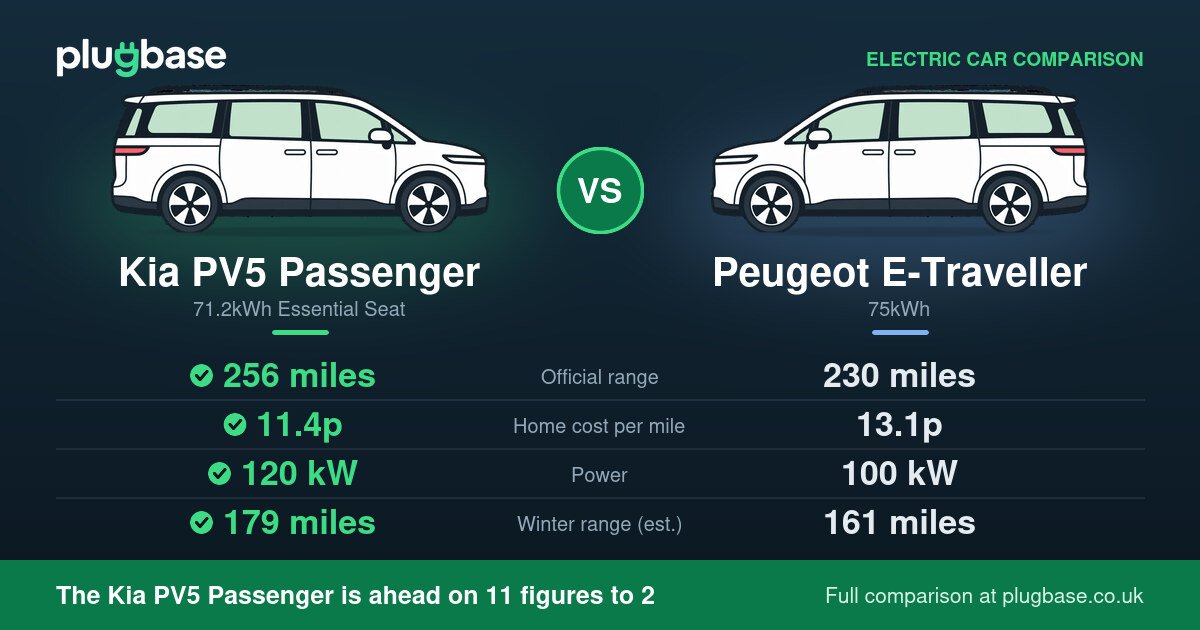
The link opens this comparison. Links shared on social media show this card as the preview.
FAQ
Kia PV5 Passenger vs Peugeot E-Traveller: questions and answers
Which has the longer range, the Kia PV5 Passenger or the Peugeot E-Traveller?
The Kia PV5 Passenger has the longer official range: 256 miles against 230 miles for the Peugeot E-Traveller. In winter, Plugbase estimates about 179 miles for the Kia PV5 Passenger and 161 miles for the Peugeot E-Traveller. We compared the Kia PV5 Passenger 71.2kWh Essential Seat and the Peugeot E-Traveller 75kWh.
Which is cheaper to run, the Kia PV5 Passenger or the Peugeot E-Traveller?
Charging at home on the standard price cap rate, the Kia PV5 Passenger costs about 11.4p a mile and the Peugeot E-Traveller about 13.1p. On the cheapest EV tariff rate we track it is 2.7p and 3.1p a mile. The Kia PV5 Passenger is the cheaper of the two to run. These are Plugbase estimates from each car's official efficiency.
How far do the Kia PV5 Passenger and Peugeot E-Traveller go in winter?
We estimate about 179 miles for the Kia PV5 Passenger and 161 miles for the Peugeot E-Traveller in cold weather, against official ranges of 256 and 230 miles. Winter range is lower for every electric car because of battery temperature and cabin heating.
Should I buy the Kia PV5 Passenger or the Peugeot E-Traveller?
The Kia PV5 Passenger is the better choice if you want more range, goes further in winter, cheaper to run. Drive both if you can, and compare prices and finance offers, which change often.
More comparisons
Other rivals to compare

Compare
Compare two other cars
Car data updated 27 November 2026 (PV5 Passenger) and 27 November 2026 (E-Traveller) · tariffs checked 28 Nov 2026


