Electric car comparison
BMW i5 vs Mercedes-Benz CLA (electric)
Two electric saloons compared on range, charging, running costs and size, using each maker's official figures and our own estimates.
Verdict
Which is better: BMW i5 or Mercedes-Benz CLA (electric)?
In short
The BMW i5 and the Mercedes-Benz CLA (electric) are both electric saloons. The Mercedes-Benz CLA (electric) goes further on a charge: 421 miles of official range against 385, about 9% more. The Mercedes-Benz CLA (electric) accepts more power on a rapid charger: up to 320 kW against 205 kW. Charged at home on the standard price cap rate, the Mercedes-Benz CLA (electric) is cheaper to run: about £850 a year at 10,000 miles, against £870. Overall the Mercedes-Benz CLA (electric) comes out ahead: it is clearly better on 9 of the 22 figures we have for both cars, the BMW i5 on 4. Which one suits you depends on what you need most, so we explain each difference below.
How many figures each car is clearly ahead on, out of 22 we have for both. Not every figure matters equally, so read the reasons below.
Choose the BMW i5 if you want…
- More powerful: 250 kW (335 bhp), against 200 kW (268 bhp)
Choose the Mercedes-Benz CLA (electric) if you want…
- More range: 421 miles official range, against 385
- Goes further in winter: about 295 miles in winter, against 270
- Faster rapid charging: up to 320 kW on a rapid charger, against 205 kW
All Mercedes-Benz CLA (electric) versions · Charging times and costs
Head to head
The figures that matter most
BMW i5 CLA (electric)
In detail
BMW i5 vs Mercedes-Benz CLA (electric): what the differences mean for you
Range and long journeys
Cold weather cuts the range of every electric car, because the battery works less efficiently and the heating draws power. We estimate about 270 miles for the BMW i5 and 295 miles for the Mercedes-Benz CLA (electric) on a winter day, against 347 and 379 in summer. At a steady 70 mph in mild weather, expect around 289 miles from the BMW i5 and 316 from the Mercedes-Benz CLA (electric). On a long trip you will usually drive between 10% and 80% charge, which is worth roughly 202 and 221 motorway miles between stops.
Charging at home and on the road
On a rapid charger the BMW i5 accepts up to 205 kW and the Mercedes-Benz CLA (electric) up to 320 kW. Peak power is only held briefly, so treat it as a guide to how quickly each car recharges. At home on a typical 7 kW wallbox, a top-up from 10% to 80% takes about 8 h 30 min for the BMW i5 and 8 h 55 min for the Mercedes-Benz CLA (electric), so either fits comfortably into an overnight charge.
Running costs
Running costs come down to efficiency: the BMW i5 covers 4.2 miles per kWh officially and the Mercedes-Benz CLA (electric) 4.3. At home on the standard price cap rate (26.32p per kWh), that works out at about £870 and £850 a year at 10,000 miles. On an EV tariff such as EDF Pod Point Plug & Power, charging off-peak, it drops to around £204 and £200 a year. Without a home charger, relying on rapid chargers at the UK average of 82p per kWh, expect about £2,569 and £2,509 a year. Vehicle tax is the same for both: £200 a year at the standard rate.
Side by side
Full specs compared
The better figure is marked . A dash means we do not have a sourced figure yet.
Range and efficiency
| Figure | BMW i5 | CLA (electric) |
|---|---|---|
| Official range (WLTP) | 385 miles | 421 miles |
| Real-world range, summerPlugbase estimate | 347 miles | 379 miles |
| Real-world range, winterPlugbase estimate | 270 miles | 295 miles |
| Motorway range at 70 mphPlugbase estimate | 289 miles | 316 miles |
| Official city range (WLTP) | 474 miles | 481 miles |
| EfficiencyOfficial, miles per kWh | 4.2 mi/kWh | 4.3 mi/kWh |
Battery and charging
| Figure | BMW i5 | CLA (electric) |
|---|---|---|
| Battery | 81.2 kWh usable | 85 kWh usable |
| Peak rapid charging (DC) | 205 kW | 320 kW |
| Max AC chargingHome and public AC chargers | 11 kW | 11 kW |
| Empty to full, 7 kW home chargerPlugbase estimate | 12 h 10 min | 12 h 45 min |
| Empty to full, 11 kW chargerThree-phase, Plugbase estimate | 8 h 10 min | 8 h 35 min |
| Empty to full, 3-pin plugPlugbase estimate | 39 h | 41 h |
| Heat pump | – | Standard |
| Charging socket | Rear right | – |
Running costs
| Figure | BMW i5 | CLA (electric) |
|---|---|---|
| Cost per mile, home chargingStandard price cap rate | 8.7p | 8.5p |
| Cost per mile, EV tariffCheapest off-peak rate we track | 2p | 2p |
| Cost per mile, rapid chargingUK average rapid price | 25.7p | 25.1p |
| Full charge at homeStandard price cap rate | £23.75 | £24.86 |
| Full charge on an EV tariffCheapest off-peak rate we track | £5.58 | £5.84 |
| Rapid charge 10–80%UK average rapid price | £49.06 | £51.36 |
| Vehicle tax, first year | £10 | £10 |
| Vehicle tax, standard rateA year, from the second tax payment | £200 | £200 |
Performance
| Figure | BMW i5 | CLA (electric) |
|---|---|---|
| Power | 250 kW (335 bhp) | 200 kW (268 bhp) |
| 0–62 mph | 5.7 sec | – |
| Top speed | 120 mph | – |
| Drive | Rear-wheel drive | – |
Size and practicality
| Figure | BMW i5 | CLA (electric) |
|---|---|---|
| Seats | 5 | 5 |
| Length | 5,060 mm | – |
| Width | 1,900 mm | – |
| Height | 1,515 mm | – |
| Wheelbase | 2,995 mm | – |
| Kerb weight | 2,150 kg | – |
Ownership and safety
| Figure | BMW i5 | CLA (electric) |
|---|---|---|
| Battery warranty | 8 years / 100,000 miles | – |
Comparing the BMW i5 Saloon eDrive40 M Sport and the Mercedes-Benz CLA (electric) Saloon 250 +. Estimates use each car's official figures; real range and costs depend on the weather, speed and how you charge.
Calculator
What each would cost you to charge
Set your miles and how you charge.
Electricity only, from each car's official efficiency adjusted for year-round driving and charging losses. Plug-in hybrids: electric miles only. Standing charges and fees are not included.
Share
Share this comparison
Send the result card to someone you are choosing with, or post it.
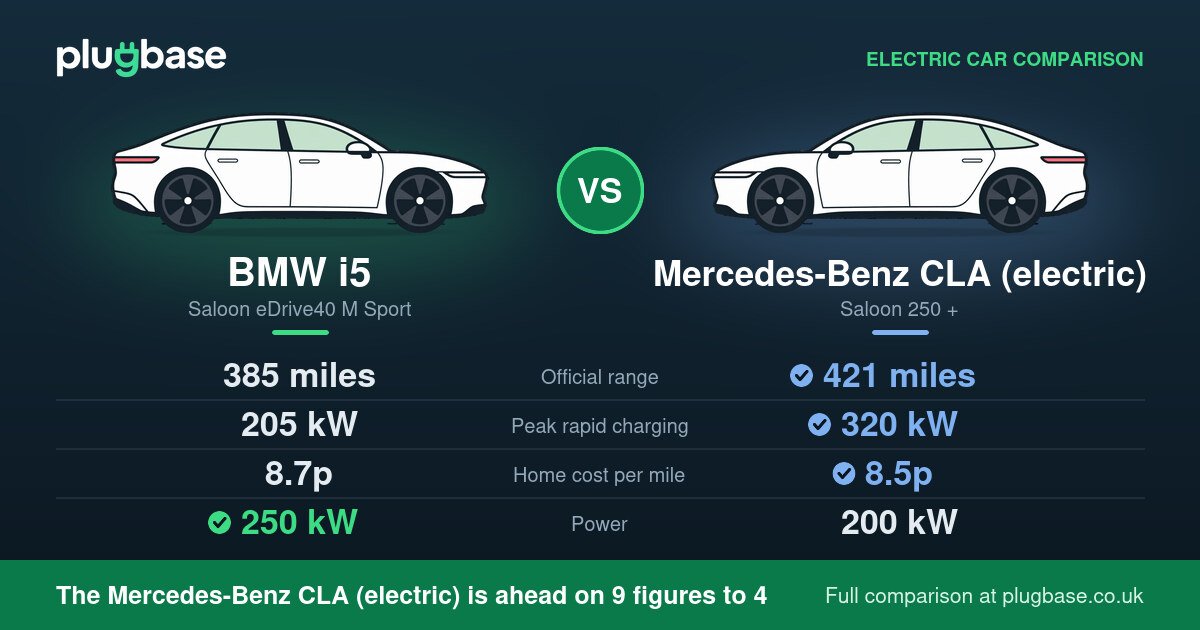
The link opens this comparison. Links shared on social media show this card as the preview.
FAQ
BMW i5 vs Mercedes-Benz CLA (electric): questions and answers
Which has the longer range, the BMW i5 or the Mercedes-Benz CLA (electric)?
The Mercedes-Benz CLA (electric) has the longer official range: 421 miles against 385 miles for the BMW i5. In winter, Plugbase estimates about 270 miles for the BMW i5 and 295 miles for the Mercedes-Benz CLA (electric). We compared the BMW i5 Saloon eDrive40 M Sport and the Mercedes-Benz CLA (electric) Saloon 250 +.
Which charges faster, the BMW i5 or the Mercedes-Benz CLA (electric)?
On a rapid charger the BMW i5 takes up to 205 kW and the Mercedes-Benz CLA (electric) up to 320 kW. A higher peak usually means shorter stops, but the full charging curve matters too.
Which is cheaper to run, the BMW i5 or the Mercedes-Benz CLA (electric)?
Charging at home on the standard price cap rate, the BMW i5 costs about 8.7p a mile and the Mercedes-Benz CLA (electric) about 8.5p. On the cheapest EV tariff rate we track it is 2p and 2p a mile. The Mercedes-Benz CLA (electric) is the cheaper of the two to run. These are Plugbase estimates from each car's official efficiency.
How far do the BMW i5 and Mercedes-Benz CLA (electric) go in winter?
We estimate about 270 miles for the BMW i5 and 295 miles for the Mercedes-Benz CLA (electric) in cold weather, against official ranges of 385 and 421 miles. Winter range is lower for every electric car because of battery temperature and cabin heating.
Should I buy the BMW i5 or the Mercedes-Benz CLA (electric)?
The BMW i5 is the better choice if you want more powerful. The Mercedes-Benz CLA (electric) is the better choice if you want more range, goes further in winter, faster rapid charging. Drive both if you can, and compare prices and finance offers, which change often.
More comparisons
Other rivals to compare
Compare
Compare two other cars
Car data updated 27 November 2026 (BMW i5) and 27 November 2026 (CLA (electric)) · tariffs checked 28 Nov 2026


